BY ERIKA MCCARTHY, MMS SENIOR EDITOR AND WRITER
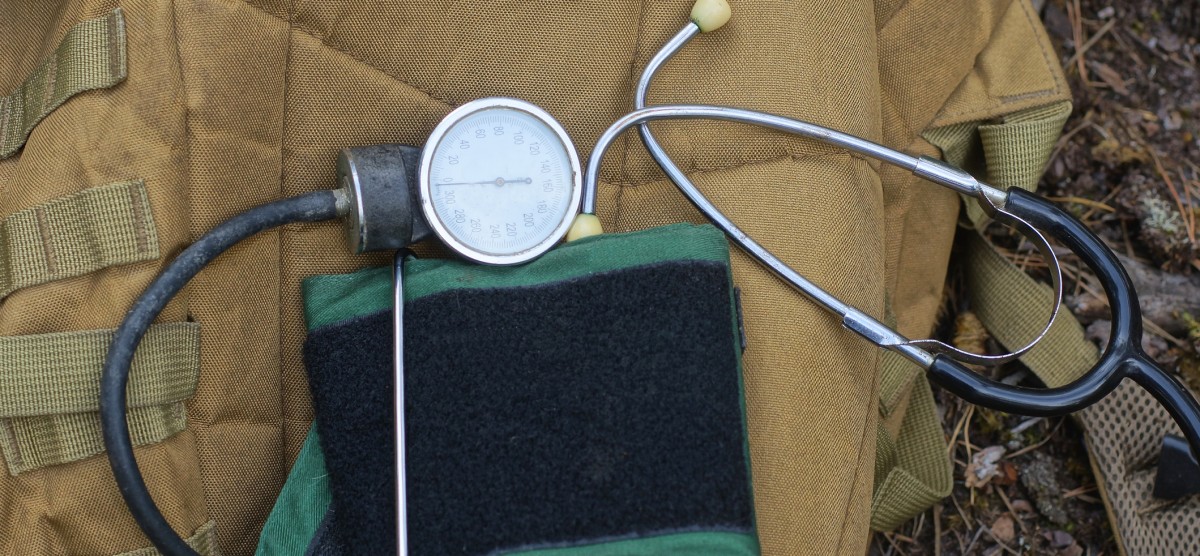
Image by huettenhoelscher via Getty Images.
Medicine is often described as a calling. For some Massachusetts Medical Society (MMS) members, military service is a second one.
For Thomas Morris, MD, former commander of the Medical Corps of the United States Navy, and Eric Goralnick, MD, MS, former Navy officer and emergency physician, balancing both has shaped not only their careers but also their leadership and approach to
patient care.
A Calling That Wouldn’t Go Away
For Dr. Morris, a pulmonary disease specialist and assistant clinical professor of medicine at Boston University School of Medicine, the decision to join the Navy came later than most. He was commissioned into the United States Navy Medical Corps as a
reservist in 2006 — at age 55.
“It was a calling that just wouldn’t go away,” he said. “With the war on terror, I wanted to help out, and I thought I had a skill set the Navy would be interested in.”
The Navy agreed.
Called to active duty in 2010, Dr. Morris cared for service members evacuated from combat zones, gaining experience that broadened his perspective as a physician.
His work ranged from outpatient internal medicine to critical care and pulmonary medicine. Though trained as a pulmonologist, he was assigned as an internist — a reminder, he said, that in military medicine, “the needs of the service” come first.
Despite the challenges, Dr. Morris described his military years with unmistakable enthusiasm.
“I had a blast as a sailor,” he said. “I’d do it again. I wish I’d done it sooner.”
Balancing Private Practice and Military Duty
At the time he joined the Navy, Dr. Morris was running a solo pulmonary practice in Brockton that he had built over nearly four decades.
Serving while running a private practice required careful planning and support from colleagues, reinforcing lessons in adaptability and time management.
“Like most successful people, you have to learn how to budget your time,” he said. Military service also gave him unexpected perspective on civilian medicine. Working within military systems reinforced his ability to navigate obstacles, adapt quickly,
and find efficiencies.
“I knew how to work around some of the things that others were boxed in by —protocol and doctrine,” he said. “I was able to not let them get in my way.”
Still, the emotional rewards stand out most vividly in his memory.
Years after treating a Massachusetts National Guard member in Germany for chest pain and shortness of breath, Dr. Morris unexpectedly encountered the man while making a bank deposit in Brockton.
The patient recognized him immediately.
“You’re the doctor who saved my life,” the man told him. For Dr. Morris, it affirmed why he answered the call to serve.
Leadership Through Service
For Dr. Goralnick, now serving as Secretary of the Massachusetts Executive Office of Veterans Services (EOVS), military service shaped the very foundation of his leadership philosophy.
A Naval Academy graduate, Dr. Goralnick served as a Navy officer before pursuing medicine.
“My Navy career is fundamental to who I am and how I approach most things in life,” he said.
Now an emergency physician and nationally recognized expert in health care operations and military-civilian partnerships, Dr. Goralnick says the parallels between military service and emergency medicine are striking.
“One key aspect of the Navy is you have to be comfortable dealing with uncertainty,” he said. “Every emergency medicine shift involves uncertainty — listening to patients, working through diagnoses, making decisions as a team.”
Another shared value is service itself.
“A principle I learned at the Naval Academy was ‘ship, shipmate, self,’” he said. “The mission and your teammates take priority over your own welfare.”
Even while leading EOVS, Dr. Goralnick continues to practice emergency medicine one evening each week.
“It’s my time to just focus on the person in front of me,” he said.
Supporting Veterans Beyond the Uniform
Dr. Goralnick’s current role gives him a broader view of how physicians can continue serving military communities even outside formal military service.
At EOVS, he oversees efforts to improve veterans’ access to housing, health care, employment support, and wraparound services across Massachusetts.
Among the challenges he has confronted is veteran homelessness. Massachusetts identified approximately 550 homeless veterans last year — likely an undercount.
“We can do a little in the emergency department,” he said. “But it’s very hard to get to the root of the issue. Government can help solve it.”
He emphasized that physicians do not need to enlist to support veterans. Mentorship, advocacy, and helping veterans navigate civilian systems can all make a meaningful difference.
“Veterans are very good with uncertainty. They show grit. They’re service-oriented,” he said. “It’s a perfect match for the medical world.”
Opportunities for Early-Career Physicians
Both physicians highlighted an often-overlooked pathway for medical students and early-career physicians: military scholarship programs.
The Armed Forces Health Professions Scholarship Program (HPSP), offered through the Navy, Army, and Air Force, can provide full medical school tuition, a stipend, and officer pay in exchange for future military service.
“A lot of those scholarships are left on the table,” Dr. Morris said. “It’s really a good deal. You get paid, you get a commission, and you get a job for a few years afterwards.”
Dr. Morris believes younger physicians should seriously consider the opportunity.
“Four or five years go by pretty quickly in life,” he said.
A Shared Commitment
Though their paths differed — one entering military service later in life and the other beginning at the Naval Academy — Drs. Morris and Goralnick share a common belief: military service strengthened their identities as physicians and leaders.
As Dr. Goralnick put it, “You never know what’s going to come in the door, but you’re committed to figuring it out. And you do that as a team.”
